Building a Slightly Sentient d20 PCB
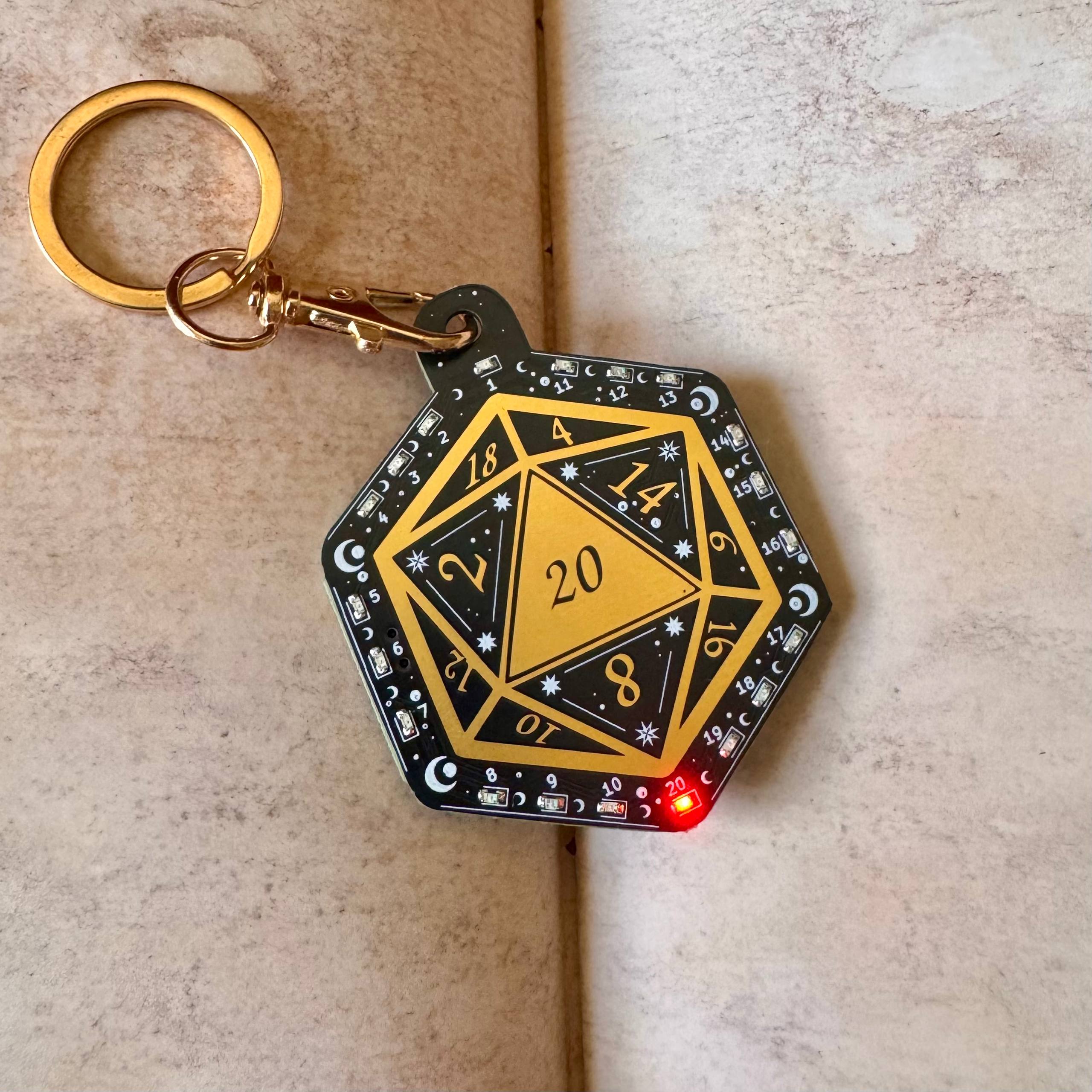
Hardware With a Role to Play
Some time ago I did what I do best: merge my DnD hyperfixation with one of my other hyperfixations. This time the result wasn't yet another Emacs mode for running pen-and-paper sessions, but something slightly more tangible: silicon.
That's how the d20 PCB was born.
While working on it I realised that hardware is actually a surprisingly good medium for storytelling. Even something as simple as a dice can develop a bit of character if you give it the right ingredients: a few rules, a bit of state, some quirks in how it behaves. Not actual intelligence of course, but enough to make the device feel like it has a personality.
Originally the board was designed as a small gift for my DnD players (I’m the DM of the group), so a lot of its behaviour is tied to the characters around the table and their particular quirks. At first glance it's just a small electronic d20. Under the hood, however, a few mechanics shape how it reacts to rolls and players over time, giving the illusion that the dice itself develops preferences and moods (and often also attitude).
Even the artwork on the PCB ties into the lore of our campaign. From schematic to layout to firmware, the entire project ended up revolving around one idea: building hardware that isn't just a tool for the story, but quietly becomes a part of it.
The Dice and Its Quirks
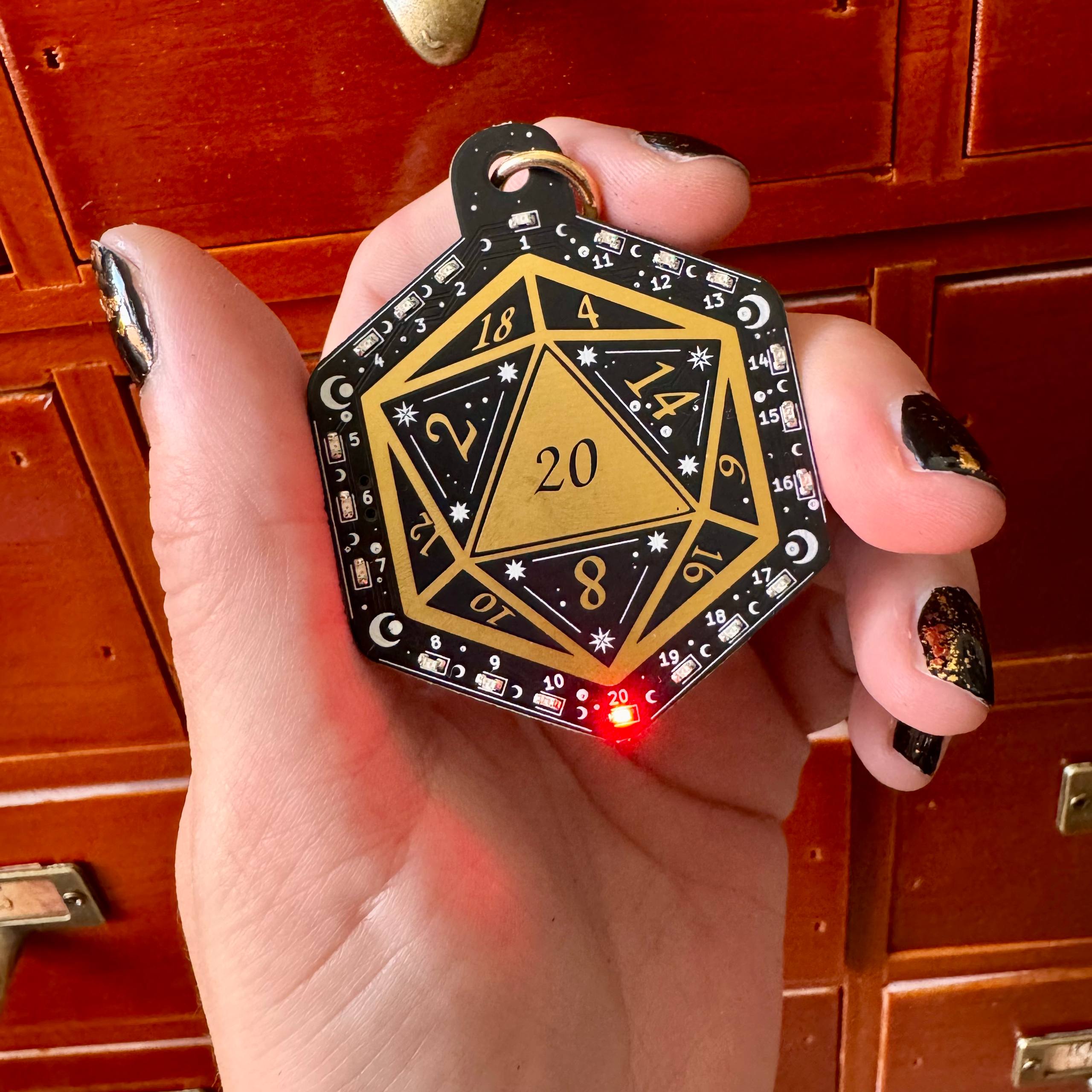
At its core the board does exactly what a dice is supposed to do: it rolls a random number. Touch the pad (or press a button), it spins through the LEDs for a moment, and then one of the twenty numbers lights up. Simple.
But after a while (i.e. quickly) the dice starts behaving a little… loaded.
The first player who uses it attunes the device. In pen-and-paper terms that means the dice bonds to a character. From that moment on it remembers who first claimed it and adjusts some of its behaviour accordingly.
It also keeps track of what happens at the table. Roll enough natural 1s and the dice may start getting a bit cranky about it. Roll enough natural 20s and it might become a little too enthusiastic instead. Over time the firmware quietly biases the rolls in response, nudging the results ever so slightly in one direction or the other.
If you really manage to upset it, the dice may even start acting out in more subtle ways: LEDs flicker a little differently, animations become slightly less reliable, and things generally feel a bit… temperamental.
There are also a few small animations triggered by special rolls, inspired by the characters in the party. And because no microcontroller project should ever ship without secrets, the firmware contains more than one easter egg waiting to be discovered.
So while the board looks like a simple electronic d20, it slowly reveals a few quirks the longer you play with it. Just enough to make the dice feel like it has a personality of its own (and only secondarily motivated by my urge to say “it's a feature, not a bug.”).
Designing a Dice With Character
At some point during development it became clear that thinking about the board in terms of features was the wrong approach.
Instead of a feature list, the dice needed something closer to a character sheet.
Once you look at it that way, the design space changes. Tracking natural 1s and 20s stops being simple bookkeeping and starts looking more like mood. A tiny bias in the RNG becomes attitude. Slightly unreliable LEDs can read less like a bug and more like the dice expressing its displeasure.
That’s the fun part about hardware as a storytelling medium. Unlike software, a physical object sits at the table with the players. It can react, remember, misbehave a little, and slowly reveal its quirks over time. Even a tiny microcontroller suddenly feels less like a tool and more like a prop that is part of the game.
Of course none of this happens by magic. Behind the scenes it’s still just a small microcontroller, a handful of LEDs, and some very opinionated firmware.
So let’s take a look under the hood.
Under the Hood
Under the surface the dice is actually a teeny-tiny embedded system.
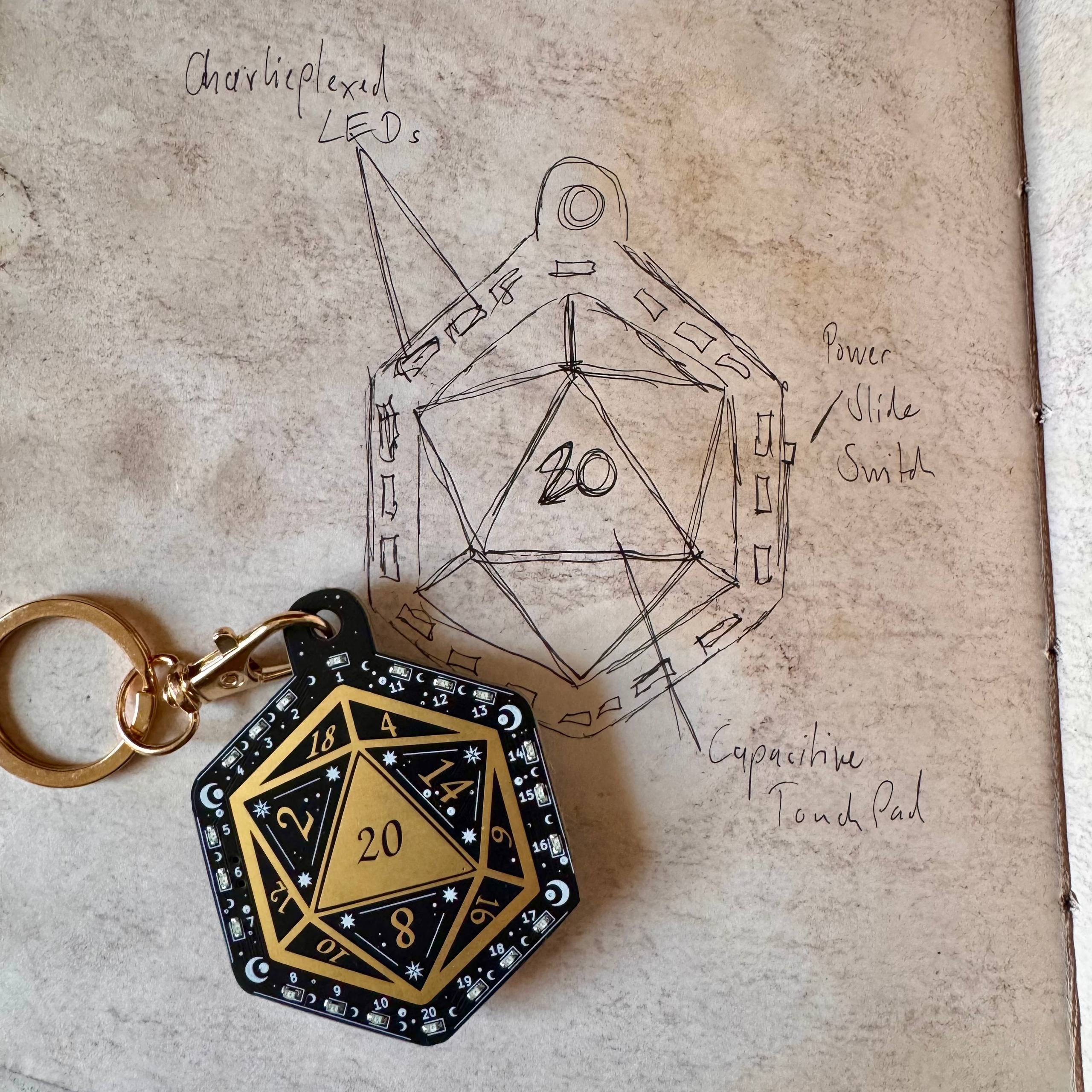
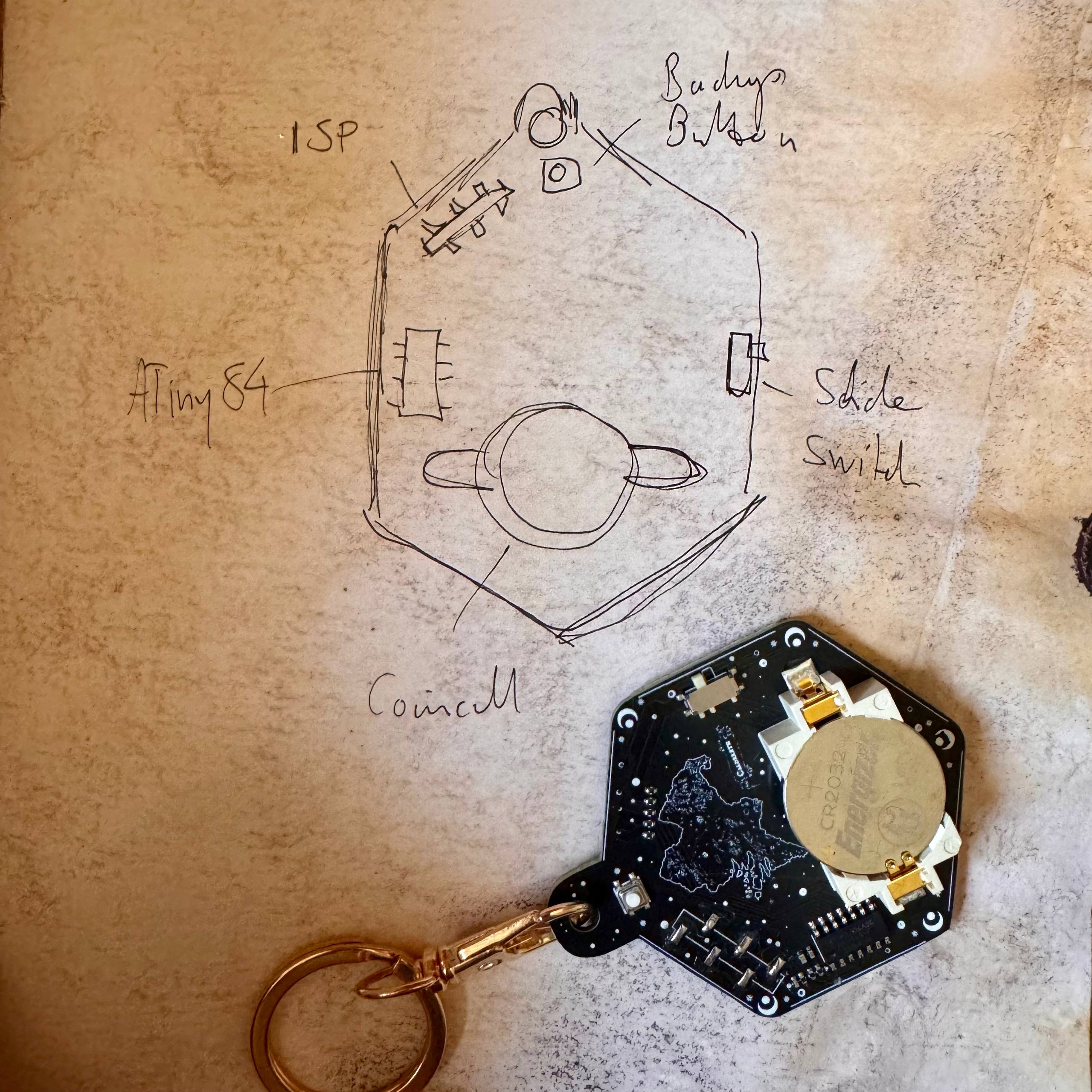
The board is built around an ATtiny84 microcontroller driving twenty LEDs arranged around the edges of a (roughly) d20-shaped PCB. To keep the board small the LEDs are charlieplexed, allowing all twenty to be driven using only a handful of GPIO pins. On a small microcontroller like the ATtiny84 that pin budget matters quite a bit, because, well, dedicating one pin per LED simply would not fit.
A capacitive touch pad acts as the primary “roll” input, with a small push button as a backup trigger. Power comes from a coin cell battery and a slide switch, and the board exposes a small ISP programming header so the firmware can be flashed or updated.
Everything sits on a PCB shaped like the outline of a twenty-sided die, with the LED positions corresponding to the numbers around the edge and the capacitive touch pad functioning as the 20.
Touch and Attunement
The touch pad does more than simply trigger a roll. The raw capacitive readings are also used to derive a small fingerprint during the first interaction with the device.
Capacitive sensing is inherently noisy and varies slightly depending on the user, environment and even how the board is held. Instead of fighting that variability the firmware takes advantage of it. During the first touch a set of samples is taken and combined into a small value that becomes the device's attunement state.
This value is stored in EEPROM so it persists even if the battery is removed.
From that point on the attunement value subtly influences various aspects of the dice's behaviour: timing, animation pacing and certain sensing thresholds. Two dice built from identical hardware can therefore still end up behaving slightly differently depending on who first "attuned" them.
The Dice State
While the dice is being used it keeps track of a few simple statistics.
Most importantly it counts natural 1s and natural 20s rolled during a session. These counters form a tiny internal state that roughly represents how the dice “feels” about the current streak of luck.
The firmware does not treat these counters as strict logic conditions. Instead they behave more like weights that influence later decisions. The state gradually drifts as the session/usage progresses, giving the dice a small memory of recent events.
Biasing the Rolls
Normally the roll result is derived from a uniform random distribution. However once the dice accumulates enough natural 1s or natural 20s the internal state begins to influence the result selection slightly.
The underlying RNG remains uniform, but the final selection step can be weighted just enough to make certain ranges of results marginally more likely. The bias is intentionally small, the goal is not to deterministically force outcomes, but to gently tilt the odds depending on the current state.
From a purely statistical perspective this is just a small modification to the selection stage of the random number generation. From a storytelling perspective it starts to look suspiciously like the dice having a mood.
When the Dice Gets Upset
If the internal counters drift too far in one direction the dice begins to express its displeasure in other ways as well.
Certain animations become more erratic, LED timing shifts slightly, and some sensing thresholds are adjusted so the device feels a bit less predictable. Because the LEDs are multiplexed through charlieplexing, even small timing changes can subtly alter the visual behaviour of the display.
None of this breaks the dice, but the overall behaviour becomes noticeably more temperamental.
In other words: the firmware starts leaning into the illusion that the dice has an attitude.
Secrets in the Firmware
Finally, like any respectable microcontroller project, the firmware also contains a few hidden behaviours.
Some are triggered by unlikely sequences of events, others require a bit of curiosity to uncover. None of them are strictly necessary for rolling dice, but they make the device a little more fun to explore.
Field Testing With Adventurers
Of course the prototypes were immediately(-ish) deployed at the table.
The dice were originally meant as a small Christmas gift for my players. Naturally they received them instantly… around Easter.
To my knowledge none of them are aware of the mechanics described in the previous sections. As far as they know it’s just a small personalised electronic d20 that lights up nicely when you roll it.
Some things did raise eyebrows though. One player accused the dice of “not being really random”. Another commented that it sometimes felt a bit buggy.
So close.
For now the dice does exactly what it was meant to do: give each player a personalised little gadget for the table. And give the DM the quiet joy of knowing a bit more about what’s going on inside.
If You Want to Build One Too
Right now I’m in the process of cleaning up the KiCAD project and the firmware before publishing anything.
The versions used at our table are heavily personalised for the individual player characters, and I’d like to keep those exactly as they are. Part of the magic is that each player’s dice is just their dice, with its own quirks and little secrets.
So the public version is getting a bit of refactoring to remove the campaign-specific parts while keeping the general mechanics intact.
Once that’s done I’ll publish the board files, firmware and a more detailed write-up on how the whole thing was built: from schematic to PCB to the slightly opinionated firmware running on the dice.
So if you'd like to build your own slightly dramatic d20, stay tuned.